Banksia Court · Episode 1
How to make sure residents read your notices
58 doors. 58 paper notices. One very happy dog.
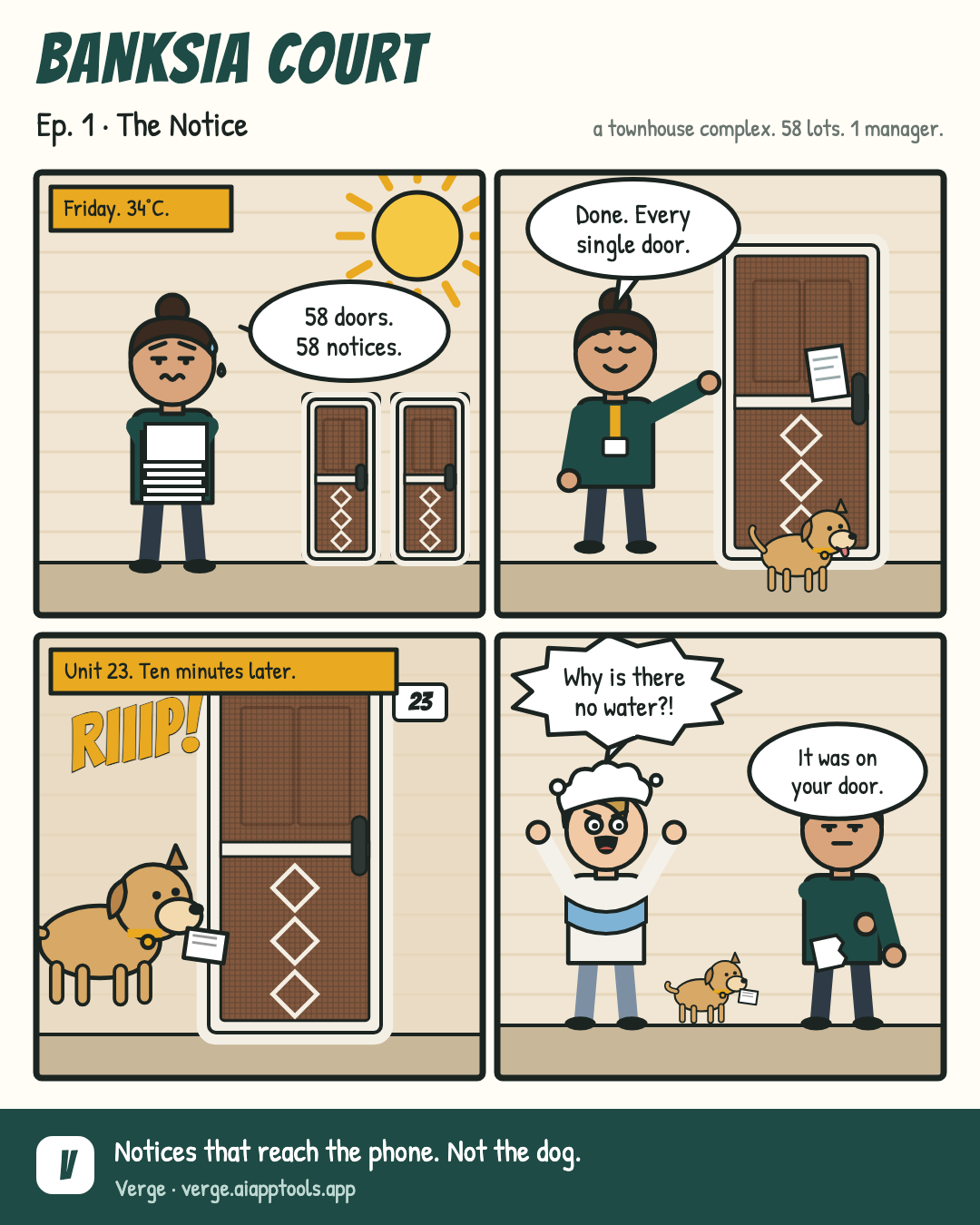
Read the comic as text
Panel 1: Friday, 34°C. Deb holds a stack of paper. "58 doors. 58 notices."
Panel 2: Deb pushes the last notice into a screen door. "Done. Every single door."
Panel 3: Unit 23, ten minutes later. The dog pulls the notice out of the door. RIIIP!
Panel 4: A resident with shampoo in his hair: "Why is there no water?!" Deb: "It was on your door."
Why paper notices fail
In a townhouse complex, the usual way to tell people about a water shut-off, pest control or a pool closure is a printed A4 sheet folded into each screen door. It takes a long walk, and then you have no idea who read it.
The sheet blows away. A child takes it inside and it goes in the bin. A renter never sees it because the owner lives somewhere else. Or the dog gets it first. When the water goes off, the manager is the one who hears about it.
Five ways to get notices read
- Send it to the phone, not the door. People check their phone many times a day. They check the screen door when they walk through it.
- Put the what and the when in the first line. "Water off Friday 9am to 12pm" works better than "Important information about upcoming maintenance".
- Send it to the right people. Some notices are for everyone, some only for owners, some only for one block. A notice that is not for you teaches you to ignore the next one.
- Send early, then remind the day before. One notice a week ahead and one short reminder the day before covers most people.
- Check who has read it. If you can see that 6 units have not opened it, you can knock on 6 doors instead of 58.
Some notices, like general meeting notices, have formal rules under your state's strata or body corporate law. This post is about everyday notices: shut-offs, works, cleaning days and pool closures.
How Verge does it
Verge is a small app for townhouse complexes of 8 to 200 houses. You write the notice once, choose who gets it, and it goes to every resident's phone. You can see who has read it. Residents do not need to install anything from an app store.
See the 2-minute demo